What Is My English Level? How to Find Out in 15 Minutes
I’ve been learning English for years — but what level am I really?
If that question sounds familiar, you’re in good company. Learners often describe themselves as “fluent,” “intermediate,” or “pretty good,” then freeze when a job form asks for a CEFR level.
The fix is simple: stop guessing and use a standardized scale. In this guide you’ll learn why your level matters, what A1–C2 actually mean, and how to find your English level in about 15 minutes with a free online test.
Find out your English level free →
Why Knowing Your Level Matters
Knowing your English level is not about ego. It’s about decisions:
- Job applications — many roles expect B1 or B2 (or ask for proof)
- Course placement — the right course starts at your band, not a random one
- Learning goals — “get better” becomes “move from B1 to B2”
- Progress tracking — retest later and see real movement
Without a clear level, you buy the wrong course, under-sell yourself on LinkedIn, or overpay for exams you may not need yet.
The CEFR Scale Explained Simply
CEFR (Common European Framework of Reference) describes English ability in six levels:
Comparison
| Level | Plain-English meaning | Everyday example |
|---|---|---|
| A1 | Beginner | “Hello, my name is…” |
| A2 | Elementary | Basic conversations about daily life |
| B1 | Intermediate | Travel, work basics, simple opinions |
| B2 | Upper-intermediate | Most professional jobs |
| C1 | Advanced | Flexible professional / academic use |
| C2 | Proficient | Near-native precision |
B2 is the workplace threshold for many roles. If you’re unsure whether you’re B1 or B2, that’s one of the most valuable things a test can clarify.
Full walkthrough with examples: CEFR levels explained (A1–C2).
Self-Assessment vs a Standardized Test
Self-assessment is useful for goal-setting — and biased.
You might underrate yourself because you notice every mistake. Or overrate yourself because you survive daily conversations with friends who help you.
A standardized CEFR test gives an outside reference point. An AI-powered online test adds convenience: take it at home, finish in one sitting, and get an instant estimate instead of waiting days.
That doesn’t replace IELTS/TOEFL when a university or visa office requires those brands by name — see CEFR vs IELTS. It does answer the everyday question: what is my English level right now?
How to Test Your Level for Free
Here’s the fastest path on TestCEFR:
- Start the free Quick Scan — take the free English level test (no payment required to begin).
- Answer adaptive questions — about 15 minutes across core skills.
- See your CEFR estimate instantly — A1 through C2.
- Optional next step — if you need proof for work, get a CEFR certificate online with verification ID and QR code.
Want the full product walkthrough? Read: Free English level test online.
What to Do With Your Result
Once you know your level:
1. Get verified if employers ask for proof
A level estimate helps you. A verified CEFR certificate helps them trust it — unique ID, QR code, shareable PDF.
2. Name weak areas honestly
If reading is strong but writing lags, practice where it hurts. Level labels are overall; skill gaps are where progress happens.
3. Set a one-band goal
“A2 → B1” or “B1 → B2” is clearer than “improve English.”
4. Retest after focused practice
Use the same free scan later to check movement — not every week, but after a real study block.
Common Mistakes When Guessing Your Level
- Calling yourself “fluent” with no CEFR label — employers can’t compare that
- Assuming classroom grades = CEFR — not always aligned
- Confusing conversation comfort with professional writing — B2 often fails people on email, not chat
- Skipping proof — if a job asks for a certificate, an estimate alone may not be enough
FAQ
How do I know what my English level is?
Take a CEFR-aligned test. Free online options like TestCEFR’s Quick Scan give an A1–C2 estimate in about 15 minutes.
Is intermediate B1 or B2?
Usually B1 = intermediate and B2 = upper-intermediate. Many jobs quietly expect B2.
Do I need a certificate to know my level?
No. Testing is enough to know. A certificate is for when you need to prove it.
Conclusion
What is my English level? shouldn’t be a mystery. Use CEFR, take a short standardized test, and walk away with a clear A1–C2 answer — then certify only if you need shareable proof.
Find your English level free → · CEFR levels explained · Get a CEFR certificate
Ready to know your level?
Free CEFR Quick Scan in ~15 minutes — optional verified certificate for $9.99.
Related Articles
CEFR vs IELTS: Which English Test Should You Take?
Jul 23, 2026
CEFR Levels Explained: A1, A2, B1, B2, C1, C2 Complete Guide
Jul 23, 2026
Free English Level Test Online — Get Your CEFR Result in 15 Minutes
Jul 23, 2026
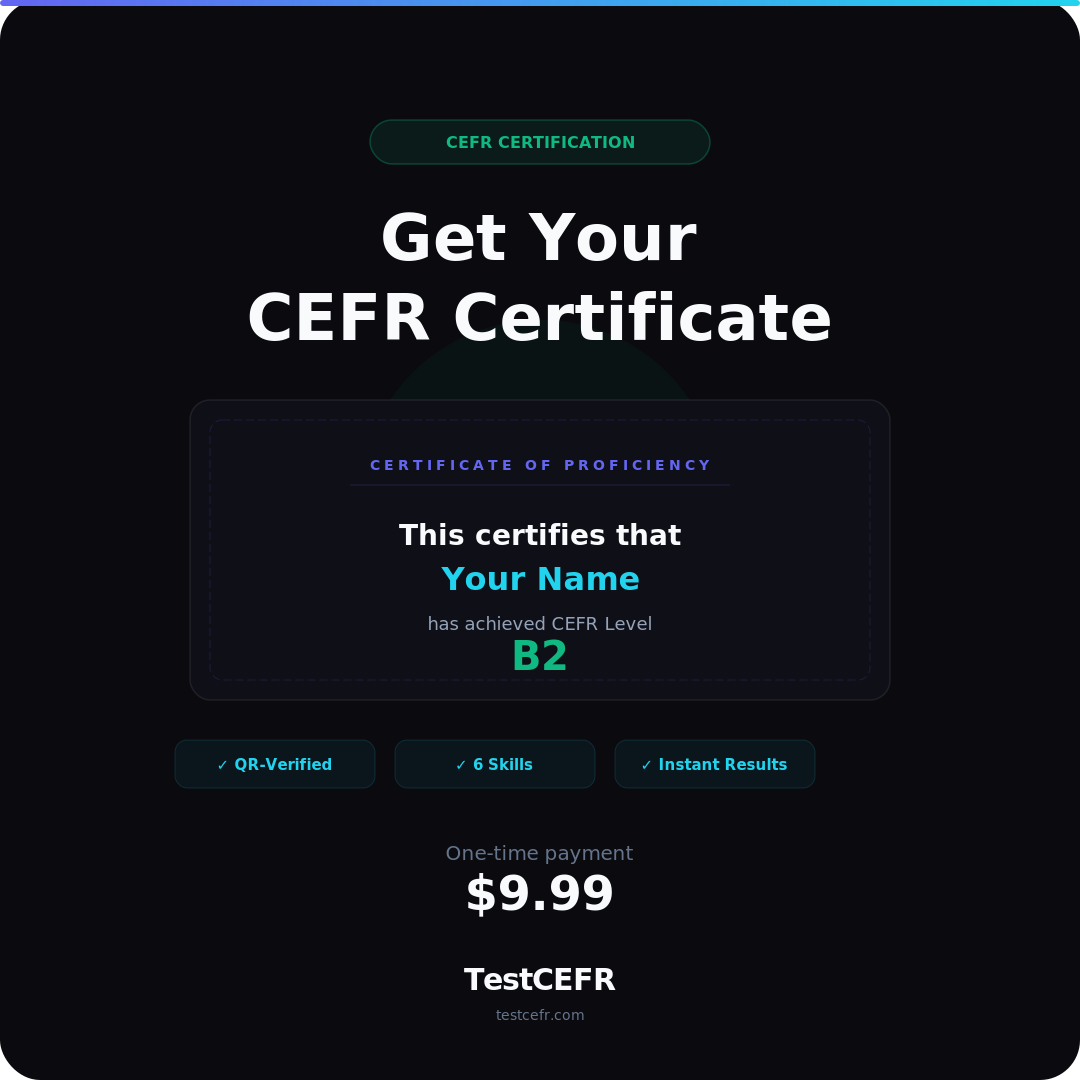
CEFR Certificate Online: How to Get Verified in 30 Minutes
Jul 23, 2026