CEFR Levels Explained: A1, A2, B1, B2, C1, C2 Complete Guide
The CEFR (Common European Framework of Reference for Languages) is the global yardstick for describing English ability. Instead of “intermediate” or “fluent,” CEFR uses six clear levels: A1, A2, B1, B2, C1, and C2.
Employers, schools, and governments use CEFR because it answers a practical question: What can this person actually do in English?
This guide explains every level with examples, typical goals, and how long learners often take to reach it. When you’re ready, you can test your English level free in about 15 minutes.
CEFR A1 — Beginner
At A1, you can understand and use familiar everyday expressions and very basic phrases.
You can:
- Introduce yourself and others
- Ask and answer simple questions about personal details
- Interact slowly if the other person helps
Example tasks: ordering a coffee with support, reading a basic form, saying where you live.
Who needs A1: complete beginners, early travelers.
Time to reach (rough): 60–100 hours of guided learning.
CEFR A2 — Elementary
At A2, you can communicate in simple, routine tasks requiring a direct exchange of information.
You can:
- Describe your family, shopping, work, and local area in simple terms
- Handle short social exchanges
- Understand frequently used expressions
Example tasks: asking for directions, writing a short personal message, following basic instructions at work.
Who needs A2: basic workplace communication, everyday life abroad.
Time to reach (rough): 180–200 cumulative hours.
IELTS-ish band (approx.): 3.0–4.0
CEFR B1 — Intermediate
B1 is where many learners feel “I can survive.” You can deal with most travel situations and produce simple connected text on familiar topics.
You can:
- Describe experiences, dreams, hopes, and ambitions
- Give brief reasons and explanations for opinions
- Understand the main points of clear standard input on familiar matters
Example tasks: handling a customer complaint with help, writing a short work email, joining a simple meeting.
Who needs B1: customer service, hospitality, study-abroad prep, many entry roles.
Time to reach (rough): 350–400 cumulative hours.
IELTS-ish band (approx.): 4.0–5.0
CEFR B2 — Upper-Intermediate (the workplace threshold)
B2 is the level most professional roles quietly expect. You can understand the main ideas of complex text and interact with enough fluency for regular work.
You can:
- Take an active part in discussions in familiar contexts
- Produce clear, detailed text on a wide range of subjects
- Explain a viewpoint giving advantages and disadvantages
Example tasks: leading a short meeting agenda item, writing a clear project update, following a training webinar.
Who needs B2: most office jobs, many university pathways, remote/freelance work with international clients.
Time to reach (rough): 500–600 cumulative hours.
IELTS-ish band (approx.): 5.5–6.5
If your goal is a job application, B2 is often the target to aim for — then prove it with a verifiable CEFR certificate.
Why B2 gets so much attention
Hiring managers rarely say “we need CEFR B2” in every job ad — but they do expect people who can:
- Follow meetings without constant clarification
- Write emails that don’t need rewriting
- Handle customer or stakeholder conversations calmly
That cluster of skills sits around B2. If you are solidly B1, you can work in English with support. If you are solidly B2, you can usually work in English as a default.
CEFR C1 — Advanced
At C1, you can use English flexibly and effectively for social, academic, and professional purposes.
You can:
- Express ideas fluently and spontaneously without much searching for expressions
- Produce clear, well-structured, detailed text on complex subjects
- Understand a wide range of demanding, longer texts
Example tasks: negotiating scope on a project, writing a structured report, presenting to mixed-native audiences.
Who needs C1: management, research, specialized professional roles.
Time to reach (rough): 700–800 cumulative hours.
IELTS-ish band (approx.): 7.0–8.0
CEFR C2 — Proficient
C2 is near-native mastery for practical purposes. You can understand virtually everything heard or read and express yourself precisely.
You can:
- Summarize information from different spoken and written sources
- Reconstruct arguments in a coherent presentation
- Differentiate finer shades of meaning even in complex situations
Example tasks: high-stakes negotiation, academic publication support, specialist consulting.
Who needs C2: translators, diplomats, elite professional communication roles.
Time to reach (rough): 1,000+ cumulative hours.
IELTS-ish band (approx.): 8.5–9.0
CEFR Level Comparison Table
Comparison
| Level | Description | You can… | Time (approx.) | IELTS equiv. (approx.) |
|---|---|---|---|---|
| A1 | Beginner | Use basic phrases | 60–100h | — |
| A2 | Elementary | Handle routine tasks | 180–200h | 3.0–4.0 |
| B1 | Intermediate | Travel / work basics | 350–400h | 4.0–5.0 |
| B2 | Upper-Int. | Professional fluency | 500–600h | 5.5–6.5 |
| C1 | Advanced | Academic / professional | 700–800h | 7.0–8.0 |
| C2 | Proficient | Near-native precision | 1000+h | 8.5–9.0 |
Band mappings are approximate guides for self-orientation — institutions may publish their own conversion tables. For the full decision on exams, read CEFR vs IELTS.
How to Test Your CEFR Level
Self-rating is useful for goal-setting, but it’s biased. A standardized online assessment gives a clearer snapshot.
- Take the free English level test online (Quick Scan ~15 minutes).
- Review your CEFR estimate and skill gaps.
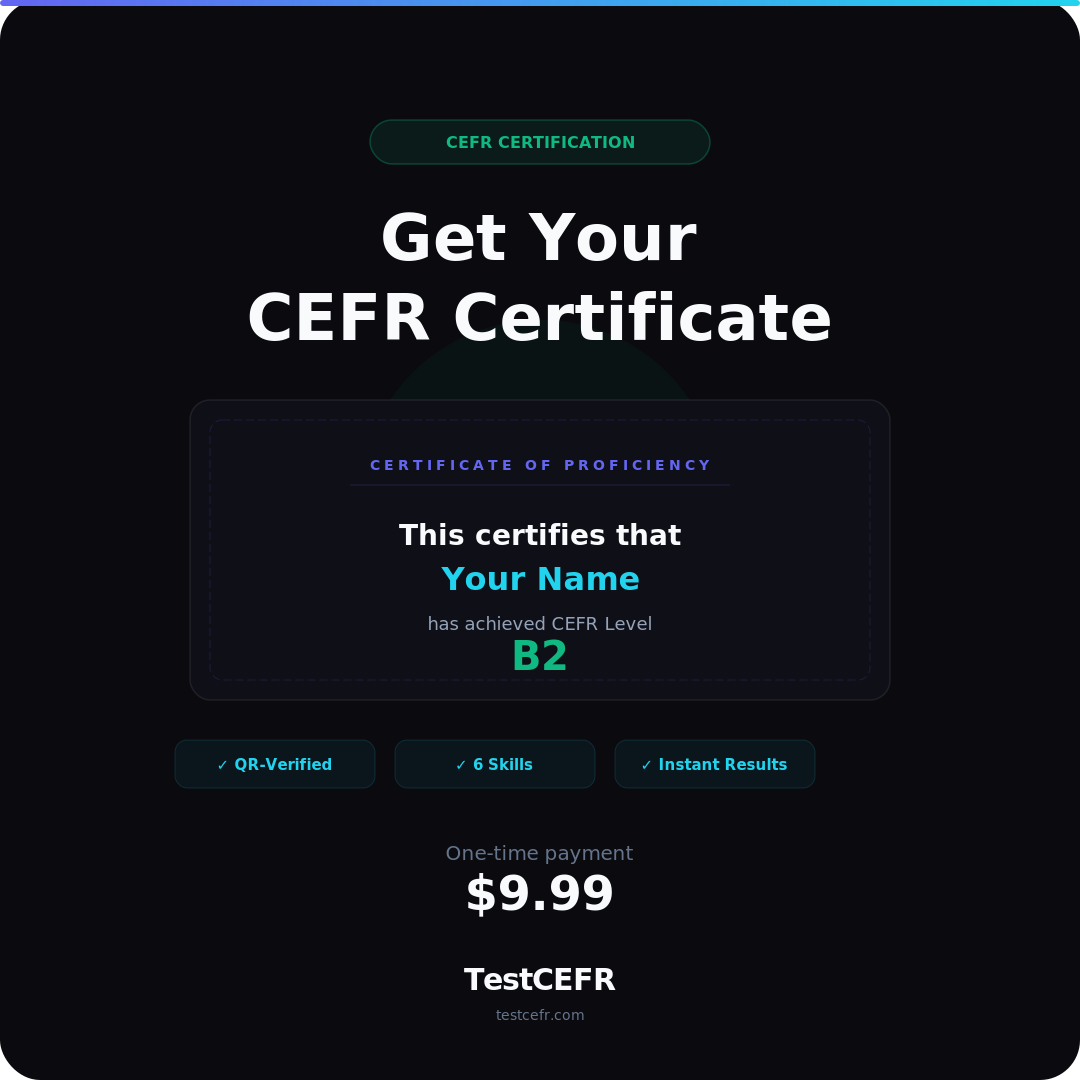
- If you need proof for work, get a CEFR certificate online with QR verification.
Not sure where you sit between B1 and B2? Start here: Take the free CEFR test →
Conclusion
CEFR levels explained simply: six steps from survival English (A1) to expert precision (C2). Most career goals cluster around B1–B2, with B2 as the common professional threshold.
Know your level, then improve with intention — and use a verifiable certificate when employers ask for proof.
Find your CEFR level free → · What is my English level?
External references
Ready to know your level?
Free CEFR Quick Scan in ~15 minutes — optional verified certificate for $9.99.
Related Articles
CEFR vs IELTS: Which English Test Should You Take?
Jul 23, 2026
Free English Level Test Online — Get Your CEFR Result in 15 Minutes
Jul 23, 2026
What Is My English Level? How to Find Out in 15 Minutes
Jul 23, 2026
CEFR Certificate Online: How to Get Verified in 30 Minutes
Jul 23, 2026